

Your SaaS MVP Is Live. What Should You Do Next?
Launching your SaaS MVP is only the beginning. Learn how to manage maintenance, control development costs, protect product ownership and turn early users into paying customers.
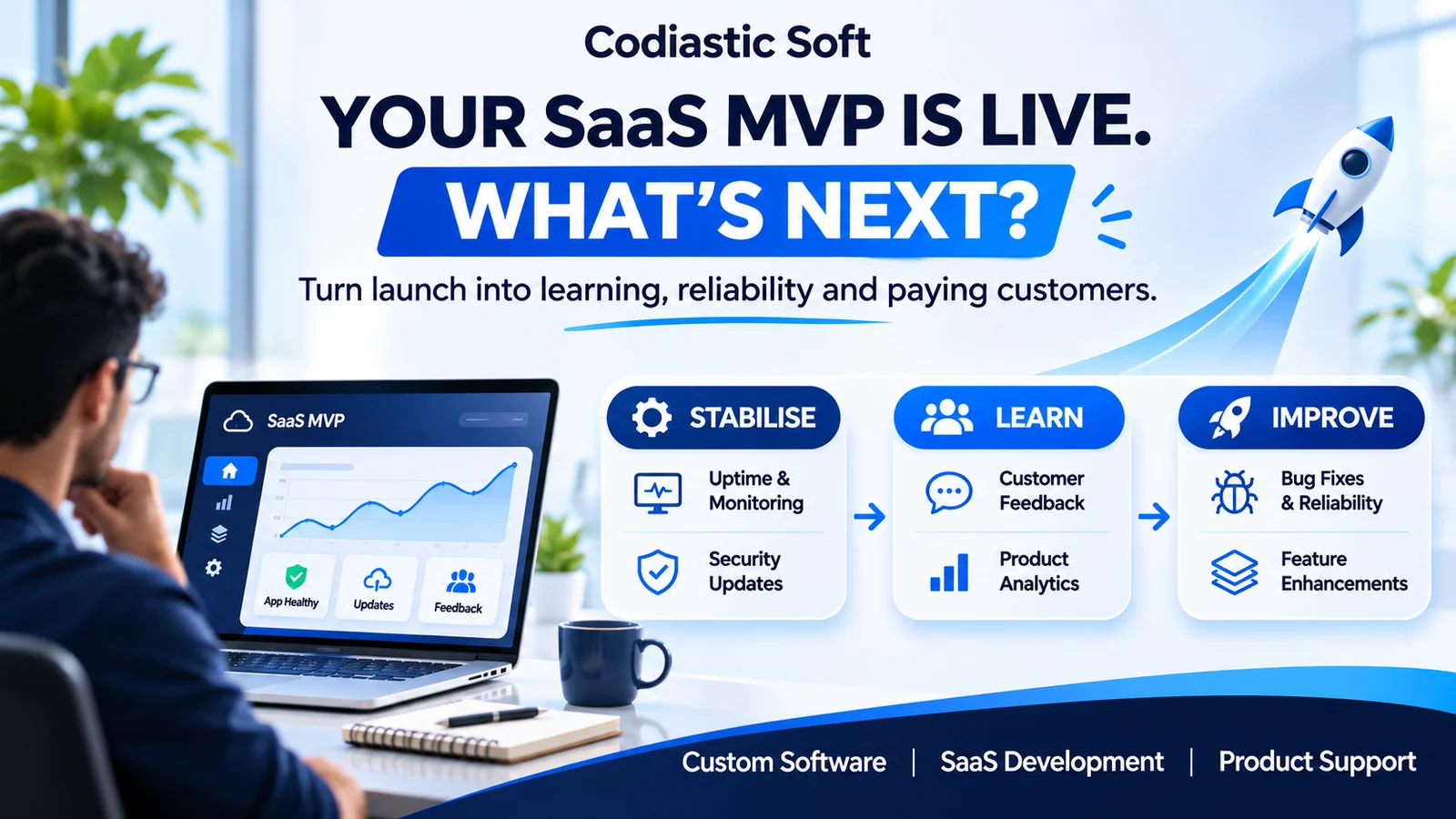
Your SaaS MVP Is Live. What Should You Do Next?
Launching a Minimum Viable Product (MVP) is a major milestone for any startup founder. After weeks or months of planning, designing and development, your software is finally available to users.
But a new challenge begins immediately after launch.
How do you maintain the product? Should you continue paying your original development team? How much should you invest in new features? And most importantly, how do you turn a working MVP into a sustainable software business?
Many founders make the mistake of treating launch as the finish line. In reality, launch is the beginning of the most important learning phase of product development.
Here is a practical roadmap for what to do after launching your SaaS MVP.
1. Stabilise the product before adding more features
Your first priority should be making sure the product works reliably for real users.
A product that performs well during a demonstration may behave differently when customers start using it with real data, different devices and unexpected workflows.
Start with these essentials:
Application and server monitoring.
Backend and frontend error tracking.
Database backups and recovery testing.
Security updates and dependency maintenance.
Payment and subscription workflow testing.
Email, notification and third-party API monitoring.
Production bug tracking and resolution.
You do not need an expensive enterprise infrastructure from day one. You need visibility into what is happening and a reliable way to recover when something fails.
Security and maintenance should also be treated as ongoing responsibilities. The UK's Software Security Code of Practice highlights the importance of secure deployment, maintenance and vulnerability management throughout a software product's supported lifetime.
2. Separate maintenance from new development
One of the most common questions founders ask after launch is whether they should continue paying the original developer every month.
The answer depends on the product's complexity, customer activity and operational requirements.
However, maintenance and new development should not be treated as the same service.
Maintenance typically includes:
Production monitoring.
Critical bug fixes.
Security patches and dependency updates.
Database backup checks.
Server and deployment support.
Incident investigation.
New development typically includes:
New modules and features.
UI and UX improvements.
Third-party integrations.
New automation workflows.
Changes to business logic.
Major architectural improvements.
Ask your development partner to define these scopes separately. Agree on what is included, how additional work is estimated and what response time applies to critical incidents.
This gives you more predictable costs and avoids paying for development that is not currently needed.
3. Focus on customers, not the feature list
Once your MVP is live, it is tempting to keep adding functionality.
A dashboard may need another chart. The admin panel may need more filters. Someone may suggest a mobile application, another integration or an advanced reporting module.
But every feature has a development and maintenance cost.
Instead, focus on learning from real users.
Talk to your first customers and observe:
Can they complete the main workflow?
Where do they get confused?
Which features do they use repeatedly?
What prevents them from paying?
Why do they stop using the product?
What would make them recommend it?
A feature should earn its place on the roadmap by solving a real customer problem or supporting a measurable business objective.
For an early-stage SaaS, customer activation, repeat usage and willingness to pay are often more valuable signals than the total number of features.
4. Make product ownership a priority
Non-technical founders do not need to understand every line of code. However, they should never lose control of their own product.
Make sure you have access to:
The source-code repository.
Domain and hosting accounts.
Cloud infrastructure and billing.
Database access and backup arrangements.
Deployment documentation.
API and integration documentation.
Third-party service accounts.
Environment configuration and access procedures.
Use company-controlled accounts wherever possible. Restrict production access appropriately and store secrets securely.
Ask your technical team to prepare a basic handover document explaining the architecture, deployment process, database, external services and recovery procedure.
This reduces dependency on any single developer or vendor.
5. Build a customer-driven product roadmap
After the first users start interacting with your product, create a prioritised backlog.
A simple classification works well:
Priority 1 — Production blockers: Bugs, downtime, payment failures and data-related issues.
Priority 2 — Customer-critical improvements: Problems that prevent users from completing the main workflow.
Priority 3 — Revenue opportunities: Features requested by prospects or existing customers that could improve conversion or retention.
Priority 4 — Future enhancements: Nice-to-have functionality that can wait.
Review this backlog regularly. Do not commit to every request immediately. Understand how frequently the problem occurs, how many customers experience it and whether solving it supports your product strategy.
6. Choose the right development arrangement
There is no single model that works for every startup.
Development arrangement | Best suited for |
|---|---|
Monthly maintenance plan | Products requiring regular technical support |
Task-based development | Occasional enhancements and planned changes |
Dedicated developer | Products with frequent releases and active iteration |
In-house technical team | Growing products with sustained engineering demand |
Development partner | Founders who need flexible access to multiple technical skills |
A small product with a stable customer base may need only planned maintenance and occasional improvements.
A SaaS product onboarding new customers every week may need more consistent engineering availability.
Choose based on actual product activity rather than assuming that a permanent development retainer is always necessary.
7. Measure whether the product is becoming a business
Your MVP should help you answer business questions, not just technical ones.
Start tracking:
New signups and completed onboarding.
Active users.
Trial-to-paid conversion.
Monthly recurring revenue (MRR), if subscription-based.
Customer retention and churn.
Support requests and recurring complaints.
Feature adoption.
Infrastructure and support costs.
These metrics help you decide whether to invest in customer acquisition, product improvements or technical stability.
A practical 30-day plan after MVP launch
Week 1: Stabilise
Review production errors, backups, security, deployment and access ownership.
Week 2: Observe
Onboard early users, conduct product demonstrations and collect feedback.
Week 3: Prioritise
Identify the most important product blockers and customer-requested improvements. Estimate the effort before committing.
Week 4: Decide
Review usage, customer interest, revenue opportunities and technical costs. Create the next development roadmap based on evidence.
How Codiastic Soft can help
At Codiastic Soft, we work on custom software development, SaaS platforms, web applications, mobile applications, AI-powered solutions and business automation.
We believe software development should not end when the first version goes live. Products need a clear technical foundation, reliable maintenance, thoughtful improvements and the flexibility to evolve with business requirements.
Whether you are planning a new SaaS MVP, need help reviewing an existing product, want to improve a live application or require a development partner for ongoing enhancements, the right approach starts with understanding your actual business goals.
Explore our software development services or see our Sosatify society management SaaS platform.
Final thoughts
Your MVP is not supposed to be a complete product. It is supposed to help you validate an idea, solve an important problem and learn from real customers.
Keep it stable. Protect ownership. Control development costs. Listen to users. Build only what moves the business forward.
The goal after launching an MVP is not to build more software. It is to build a software business that customers want to keep using.

Written by
Codiastic Soft Team
We build websites, mobile apps, SaaS products and automation for growing businesses in Pune and worldwide. About us →
Keep reading
More from our blog
SaaS & Product Development
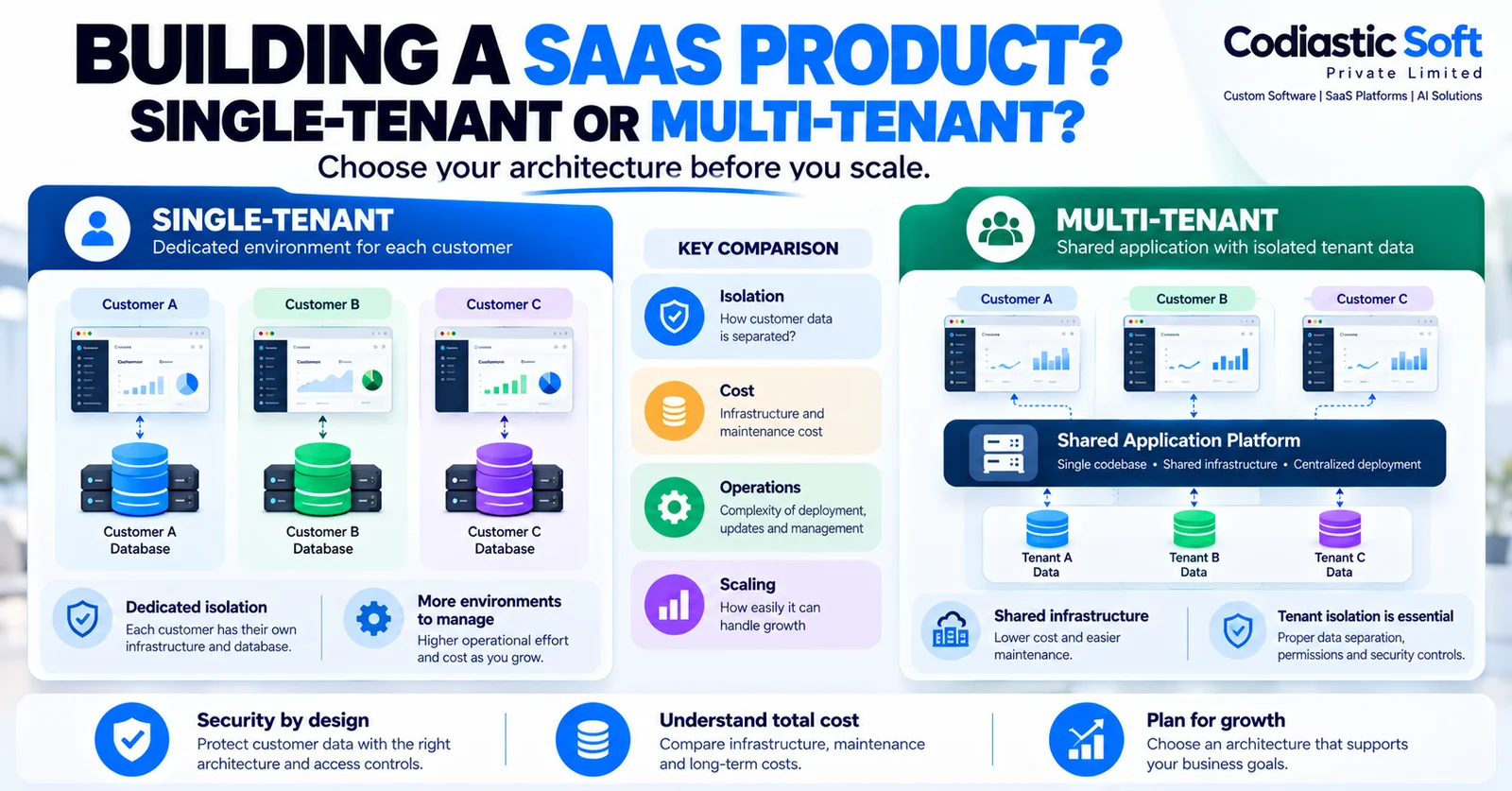
Single-Tenant vs Multi-Tenant SaaS Architecture: Which Should You Choose?
Read article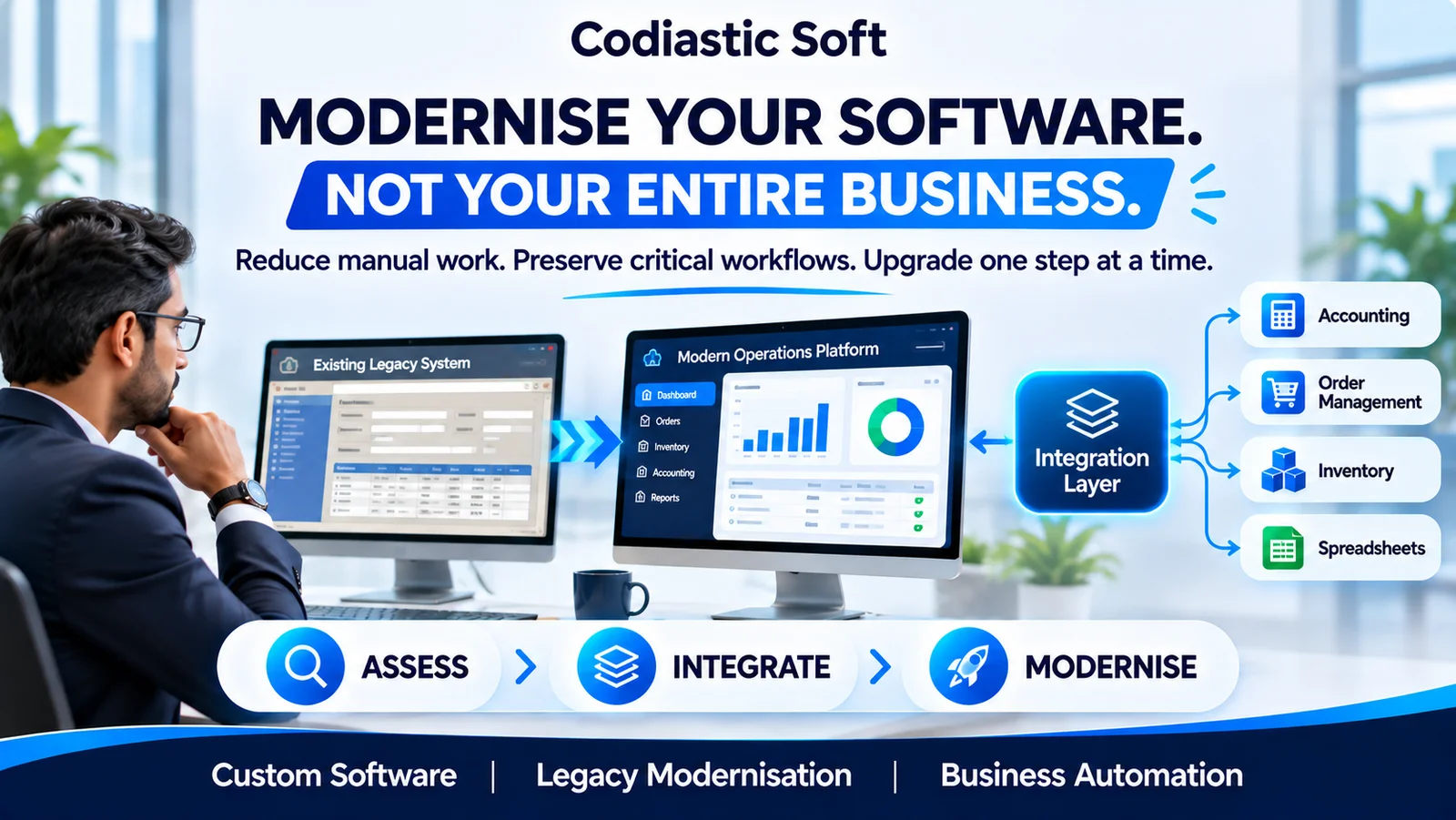
Software Development
Legacy Software Modernisation: How to Upgrade Your Business Without Disrupting Operations
Read article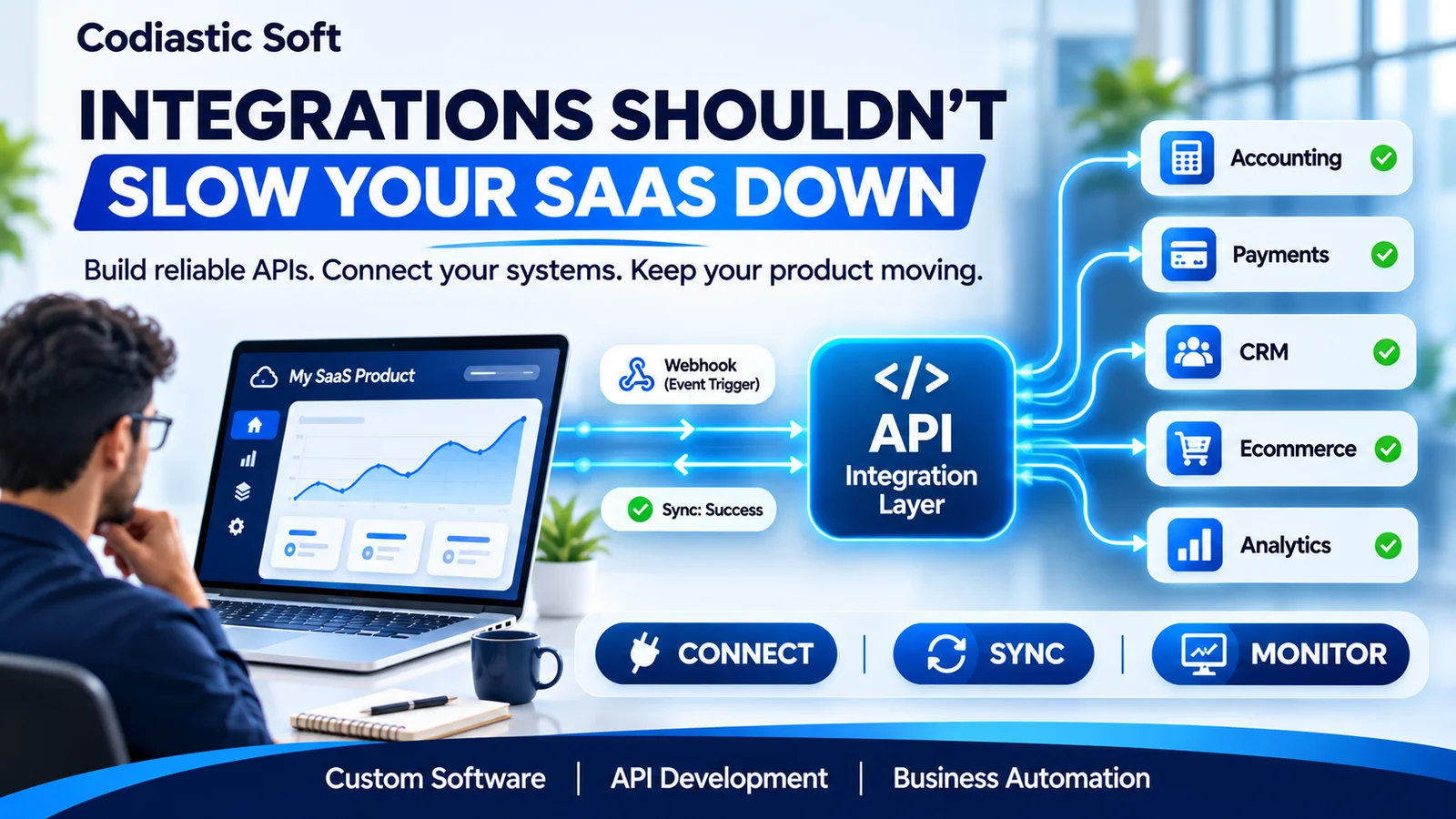
API & Integration Development