

Single-Tenant vs Multi-Tenant SaaS Architecture: Which Should You Choose?
Planning a SaaS product? Your tenant architecture affects customer-data isolation, infrastructure costs, deployment, maintenance, and scaling. Learn the difference between single-tenant and multi-tenant systems and how to choose the right approach for your product.
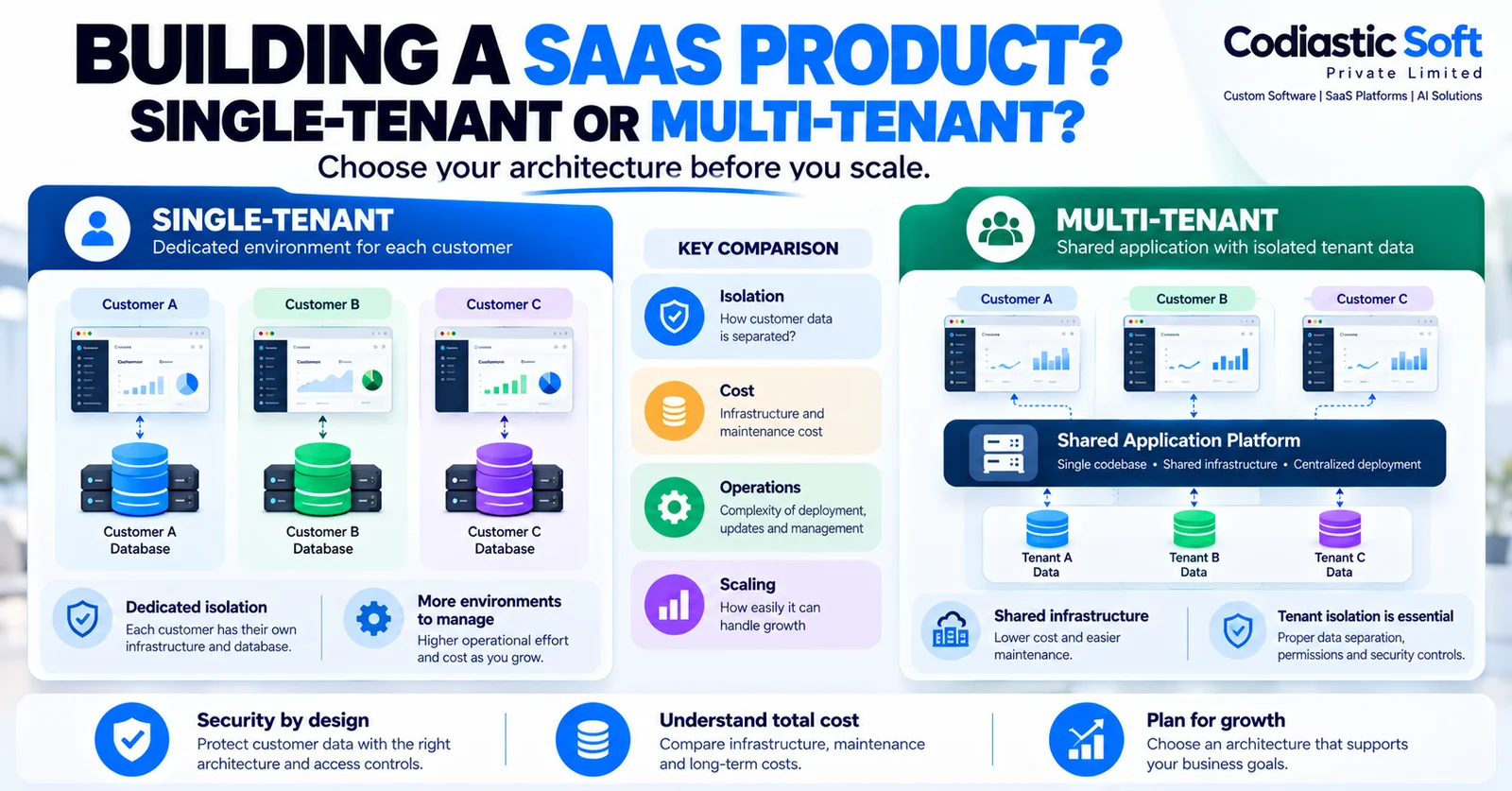
Single-Tenant vs Multi-Tenant SaaS Architecture: Which Should You Choose?
Imagine you're building a SaaS platform.
Your first customers are ready to use it. You have a product roadmap, a development budget, and a plan to acquire more businesses over the next few years.
Before development progresses too far, one architectural decision deserves attention: should each customer receive a separate application environment, or should multiple customers share the same application infrastructure while their data remains isolated?
These approaches are commonly called single-tenant and multi-tenant architecture.
Choosing between them affects more than hosting costs. It influences deployment, maintenance, security controls, customization, operational complexity, and how easily your platform can grow.
There is no universally correct option. The right architecture depends on the product you're building, the customers you're targeting, and the obligations your business must meet.
1. What is single-tenant architecture?
In a single-tenant model, each customer has a dedicated application environment. Depending on the design, that may include a separate application deployment, database, infrastructure resources, or a combination of these.
For example, if three businesses use your SaaS platform, each may have its own deployment and database environment.
This model can offer greater flexibility in how customer environments are configured, upgraded, monitored, and isolated.
Advantages
Dedicated environments: Customer workloads can be separated at the infrastructure or deployment level.
Customization flexibility: Different customers may require specific configurations, integrations, or release schedules.
Isolation options: Dedicated resources can support particular security, compliance, or contractual requirements.
Independent operations: Some customers may need separate maintenance windows or controlled upgrades.
Challenges
Higher operational overhead: More environments need provisioning, monitoring, patching, and maintenance.
Deployment complexity: Rolling out changes across many customer environments requires reliable automation.
Resource costs: Dedicated infrastructure can be expensive, especially when customer workloads are small.
Configuration drift: Environments may gradually become inconsistent if upgrades and configuration are not standardized.
Single-tenant architecture may be appropriate when customers require dedicated environments, custom deployments, particular isolation guarantees, or more independent operational control.
However, a separate environment does not automatically guarantee security. It still requires correct configuration, access controls, monitoring, and maintenance.
2. What is multi-tenant architecture?
In a multi-tenant model, multiple customers use a shared application platform while the system logically separates their data and access.
Each customer is commonly referred to as a tenant.
For example, a SaaS platform may serve hundreds of companies through one application deployment. Each company signs in and sees only its own users, records, transactions, and settings.
The application identifies the tenant associated with each request and enforces the relevant access rules throughout the system.
Multi-tenancy can use different database designs. Tenants might share database tables with a tenant identifier, use separate schemas, or have separate databases while sharing the application layer.
These options provide different trade-offs in isolation, operations, cost, and complexity.
Advantages
Shared infrastructure: Common application resources can serve multiple customers.
Simplified release management: A centrally deployed application can make updates easier to coordinate.
Efficient resource utilization: Infrastructure can be shared across customers with different usage patterns.
Consistent product experience: Features and fixes can be delivered through a common codebase.
Centralized operations: Monitoring, support, and product administration can be managed through shared tooling.
Challenges
Tenant isolation is critical: An authorization or query-filtering mistake can expose one customer's information to another.
Shared-resource contention: One tenant's heavy usage may affect other customers if workloads are not controlled.
Complex tenant-specific requirements: Different customer configurations can complicate a common product.
Broader release impact: A faulty deployment may affect multiple tenants at once.
More complex testing: Tenant boundaries must be tested across APIs, background jobs, reports, files, and integrations.
Multi-tenancy is often attractive for standardized SaaS products, but it requires deliberate design and rigorous tenant-isolation testing.
3. Single-tenant vs multi-tenant: key differences
Consideration | Single-tenant | Multi-tenant |
|---|---|---|
Application environment | Dedicated per customer | Common application serving multiple customers |
Data isolation | Can use separate databases and environments | Enforced through architecture, authorization, and data-access controls |
Infrastructure utilization | Resources may be dedicated to each customer | Resources can be shared across customers |
Deployment | More environments to coordinate | Centralized releases are often possible |
Customization | Independent customization may be easier | Standardized configuration is usually preferable |
Operations | More environments to monitor and maintain | Shared operations, with careful tenant-aware controls |
Cost pattern | Can grow with each dedicated environment | Can be efficient at scale, but shared infrastructure still has costs |
Best fit | Dedicated deployments or specific isolation needs | Standardized products serving many customers |
These are general tendencies, not guarantees. A well-designed multi-tenant platform can use separate databases, and a single-tenant system can still be poorly secured or expensive to operate.
4. How should you choose for your SaaS product?
Choose multi-tenancy when your product is standardized
Suppose you're building a subscription-based platform for service businesses.
Most customers need the same core features: user management, bookings, billing, reports, and notifications. Each business has its own account, branding settings, users, and records.
A multi-tenant architecture can allow you to deliver improvements through a shared application while keeping each business's data and permissions separate.
This can be a practical choice when your business model depends on serving many customers efficiently.
Consider single-tenancy when customers need dedicated environments
Now imagine you're developing software for large enterprises that require dedicated deployments, specific network configurations, independent release schedules, or contractual isolation requirements.
In that situation, separate customer environments may be a better fit.
You should confirm exactly what customers require. A demand for “better security” does not automatically mean that every customer needs a dedicated stack; the appropriate controls depend on the threat model, data sensitivity, and contractual obligations.
Consider a hybrid model when customer needs vary
Some SaaS businesses use a shared environment for most customers and offer dedicated environments to customers with particular requirements.
A hybrid approach can support different service tiers, but it introduces additional complexity. Provisioning, deployments, monitoring, billing, support, and upgrades must work across both models.
Do not choose a hybrid architecture merely to keep every future possibility open. Introduce it when customer needs and commercial value justify the added operational burden.
5. How do you keep customer data isolated in a multi-tenant SaaS?
Tenant isolation is one of the most important design requirements in a multi-tenant application.
Consider a property-management SaaS platform used by multiple organizations. Each organization may have its own residents, invoices, maintenance requests, and staff accounts.
The application must prevent users from accessing another organization's records, even if they manipulate an API request or change a record identifier.
Important controls include:
Reliable tenant identification
The backend should establish the tenant context using trusted authentication and authorization logic. It should not blindly trust a tenant identifier supplied by the browser.
Tenant-aware data access
Database queries and business logic must enforce tenant boundaries consistently. This includes ordinary API requests, background jobs, reports, exports, and administrative tools.
Server-side authorization
Permissions must be verified on the server for every sensitive operation. Hiding a button in the user interface is not sufficient.
Appropriate database controls
Depending on the database and architecture, constraints, row-level security, separate schemas, or separate databases may provide additional protection.
These controls must be configured and tested correctly; no single database feature replaces a complete security design.
Tenant-isolation testing
Test whether one tenant can access another tenant's records through altered IDs, direct API calls, search, reports, file downloads, and background processing.
Also test tenant onboarding, account suspension, data export, and deletion workflows.
For sensitive applications, independent security review and threat modelling may be appropriate before launch.
6. What about cost and scaling?
It is tempting to assume that multi-tenancy is always cheaper and single-tenancy is always more expensive. The real picture is more nuanced.
A single-tenant platform may require additional infrastructure for each customer, but dedicated environments can simplify some isolation or customization requirements.
A multi-tenant platform can share resources efficiently, but it still needs reliable monitoring, tenant-aware security, capacity planning, backups, and protection against one tenant consuming disproportionate resources.
Evaluate the total cost of ownership, including:
Application and database hosting.
Development and deployment automation.
Monitoring, backups, and disaster recovery.
Security controls and testing.
Support and customer-specific changes.
Scaling and performance optimization.
Maintenance and incident response.
Also consider usage patterns. A few customers with large workloads may have different infrastructure needs from hundreds of customers with light, intermittent usage.
Model realistic customer growth and workload scenarios before making cost promises.
7. Can you change architecture later?
Yes, but migration can require significant work.
Moving from single-tenancy to multi-tenancy may involve consolidating customer databases, introducing tenant-aware data models, updating authorization, migrating files, and testing data separation.
Moving from multi-tenancy to dedicated environments may require provisioning automation, deployment changes, tenant-specific configuration, and data migration.
The difficulty depends on how the application was designed initially.
You do not need to build an architecture for every imaginable future scenario. However, you should document the current assumptions, keep business logic maintainable, automate deployments where practical, and avoid coupling tenant-specific rules throughout the codebase.
A measured design that supports your current business model is usually better than premature complexity.
8. A practical decision checklist
Before finalizing your architecture, answer these questions:
Will customers use mostly the same features, or will each need extensive customization?
Do contracts or regulations require specific isolation or deployment arrangements?
How sensitive is the customer data?
What level of independent deployment or maintenance do customers require?
What are the expected customer count and workload patterns?
How will tenant identity and permissions be enforced?
How will deployments, backups, monitoring, and incident response work?
What will it cost to operate the platform as customer numbers grow?
Is a hybrid model genuinely required, or would it add unnecessary complexity?
What migration work would be needed if the business model changes?
Document the answers before committing to the database and deployment design. These decisions are much easier to evaluate before the application grows around them.
Conclusion
Single-tenant and multi-tenant architectures solve different operational problems.
Single-tenancy can be appropriate when customers need dedicated environments, independent customization, or specific isolation arrangements. Multi-tenancy can work well for standardized SaaS products that need consistent releases and efficient shared infrastructure.
A hybrid model may be useful when there is a real commercial reason to support both, but it comes with additional operational complexity.
The right decision depends on your product, customers, security requirements, workload, budget, and growth plans.
At Codiastic Soft, we develop custom software, SaaS platforms, web applications, mobile apps, and business integrations. We recommend evaluating tenant architecture as part of product planning—not after customer data and business rules have already become difficult to change.
Explore our services, portfolio, and case studies.
Build the architecture that fits your business model today while keeping future change manageable.
Frequently asked questions
Is multi-tenant architecture always better for SaaS?
No. It can be efficient for standardized products, but it requires strong tenant isolation and careful resource management. Dedicated deployments may be more appropriate for some customers.
Can multi-tenant SaaS use separate databases for each customer?
Yes. Multi-tenancy describes how customers share the application or service model, not a requirement that every customer must share the same database. Separate databases can be part of a multi-tenant design.
Is single-tenancy more secure?
Not automatically. Dedicated environments can provide useful isolation, but security still depends on configuration, identity controls, patching, monitoring, and operational practices.
Can I offer dedicated environments to enterprise customers later?
Yes, if your architecture and operations can support it. Plan for provisioning, deployments, monitoring, upgrades, and data migration before promising dedicated environments.
Which approach is cheaper?
It depends on customer workloads, infrastructure, operational automation, isolation requirements, and support costs. Compare total cost of ownership under realistic scenarios instead of assuming one model is always cheaper.

Written by
Codiastic Soft Team
We build websites, mobile apps, SaaS products and automation for growing businesses in Pune and worldwide. About us →
Keep reading
More from our blog
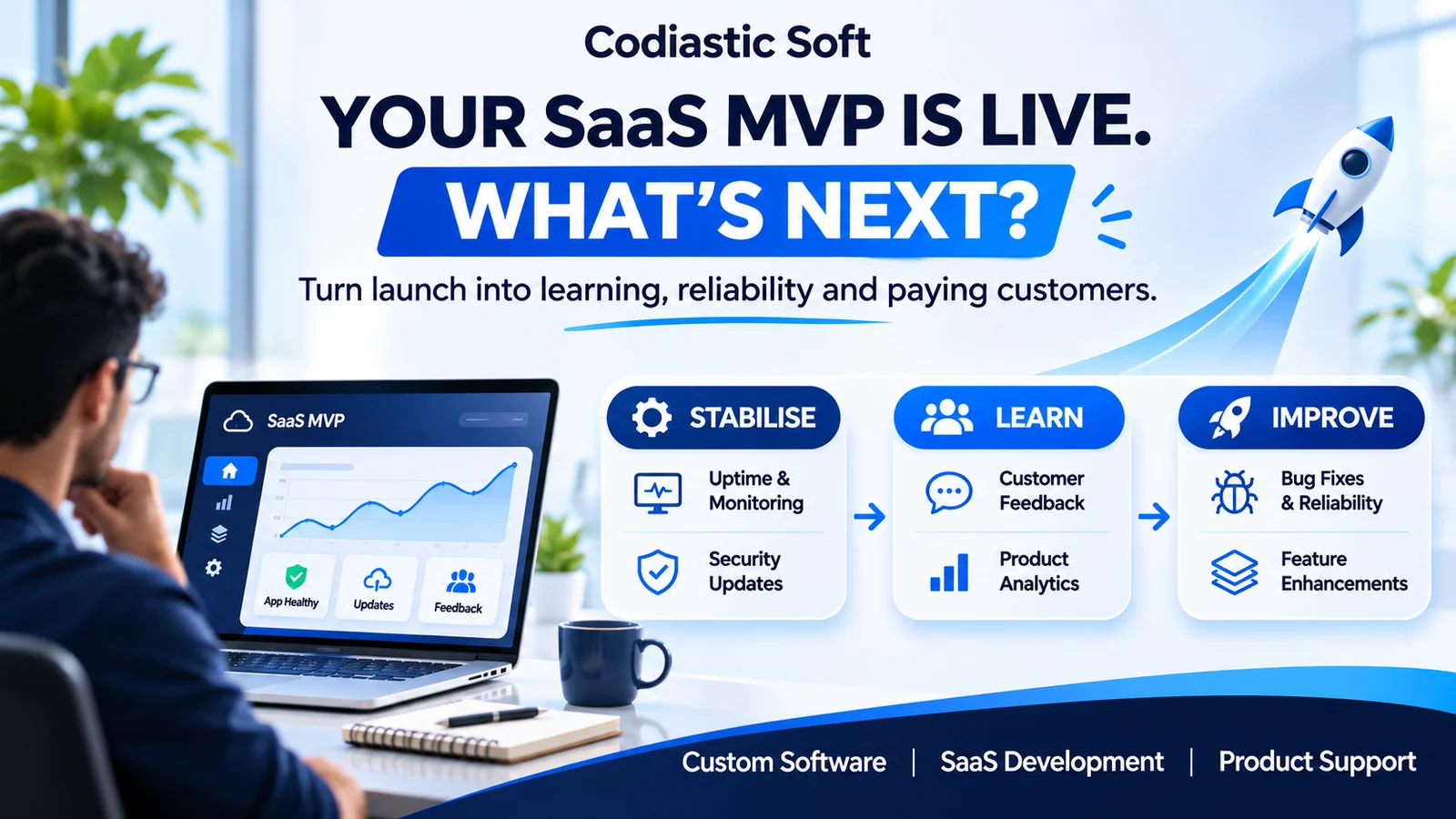
SaaS & Product Development
Your SaaS MVP Is Live. What Should You Do Next?
Read article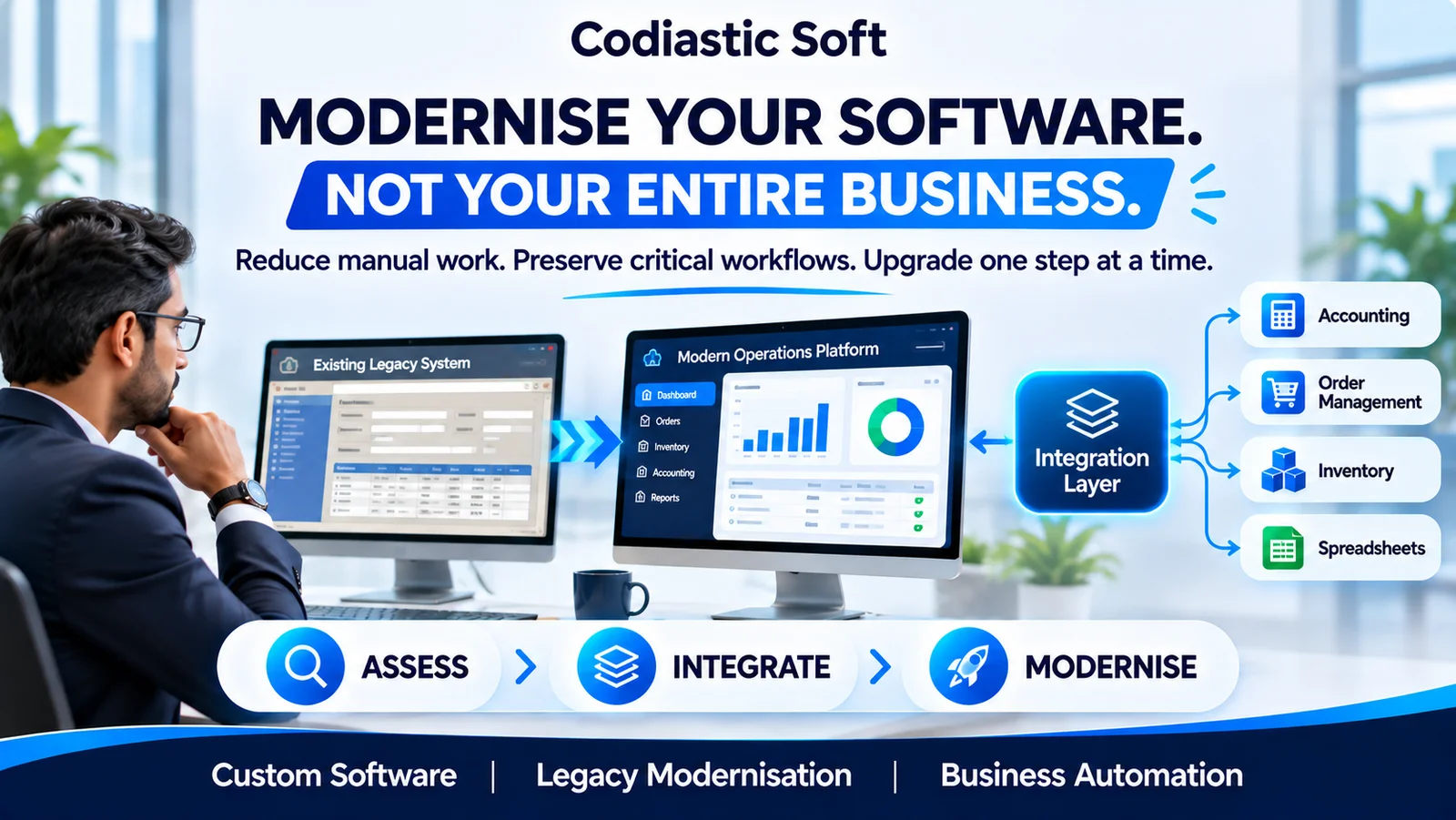
Software Development
Legacy Software Modernisation: How to Upgrade Your Business Without Disrupting Operations
Read article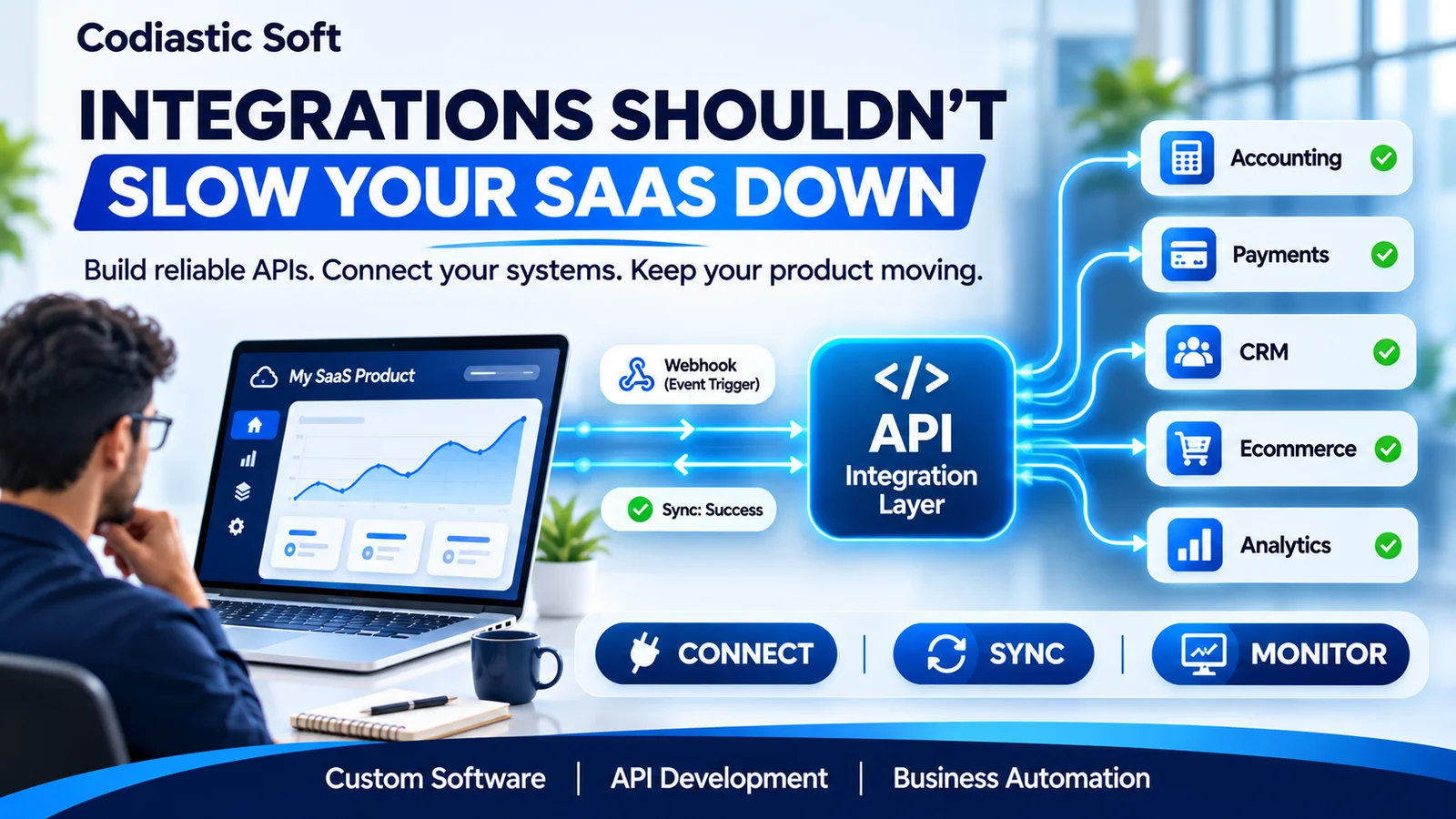
API & Integration Development