

Franchise Management Software: How to Manage Multiple Locations from One Platform
Managing one business location is very different from managing 10, 25, or 100 franchise locations. Discover how custom franchise management software can centralize operations, automate franchisee onboarding, track royalties, monitor compliance, and give business owners visibility across their entire network.
Franchise Management Software: How to Manage Multiple Locations from One Platform
The challenge of managing a growing franchise network
Imagine you operate a restaurant brand with 20 franchise locations.
Each location has its own manager, employees, sales, expenses, inventory, and day-to-day operational challenges. Your headquarters needs to know how every branch is performing, whether franchisees are following brand standards, whether royalty payments are accurate, and which locations need attention.
But the information is spread across spreadsheets, accounting software, POS systems, emails, messaging groups, and individual branch reports.
As the network grows, this creates a serious operational challenge.
The problem is not simply the number of locations. It is the lack of a connected operating system.
This is where franchise management software becomes valuable.
What is franchise management software?
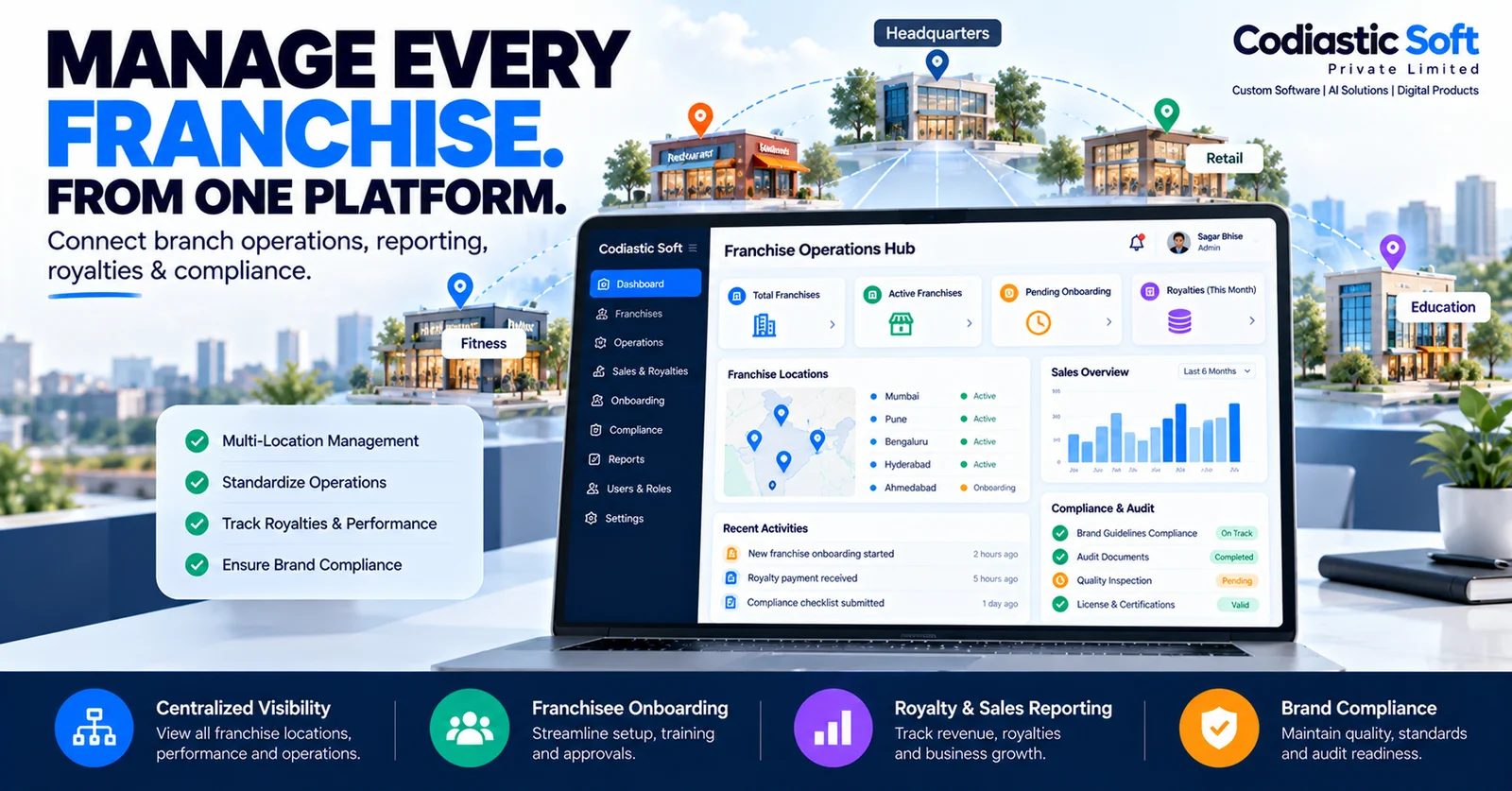
Franchise management software is a centralized digital platform that helps franchisors manage their franchise network and helps franchisees run their individual locations.
It connects headquarters, regional managers, franchise owners, and branch employees through shared workflows and controlled access.
Depending on the business model, the platform can manage:
Franchisee and branch registration
Franchise agreements and documents
Onboarding and training
Branch operations and tasks
Sales and revenue reporting
Royalty calculations and payments
Inventory and stock visibility
Brand compliance and inspections
Communication and announcements
Performance dashboards
Instead of collecting reports from every branch manually, headquarters can access consolidated information while franchisees see the data relevant to their own locations.
7 important modules in a franchise management platform
1. Franchise and location management
Maintain a centralized directory of franchise partners and locations.
Each franchise record can contain ownership details, agreement information, territory, assigned managers, operating status, opening date, and relevant documents.
The system should support a hierarchy such as:
Headquarters → Regional Manager → Franchise Owner → Branch → Employees.
This hierarchy makes it possible to manage permissions and responsibilities properly as the network expands.
2. Franchisee onboarding and document management
Opening a new franchise involves multiple activities: agreements, payments, licenses, training, setup, approvals, and operational readiness.
A digital onboarding workflow can:
Register a new franchise partner.
Collect required documents.
Track agreement and payment status.
Assign setup tasks.
Schedule training.
Record approvals.
Track opening milestones.
Management can see which onboarding activities are pending without following up through multiple calls and emails.
3. Branch operations and task management
Headquarters often needs to communicate common operating instructions to every location.
For example, a restaurant brand may introduce a new menu, update a standard operating procedure, or schedule a quality inspection.
A central operations module can publish tasks, assign deadlines, collect acknowledgements, track completion, and escalate overdue activities.
Franchisees can still manage their local operations within the permissions and standards defined by the brand.
4. Sales, revenue, and royalty management
Royalty calculations are an important part of franchise operations.
For example, suppose a franchise agreement specifies a royalty of 6% of eligible monthly sales.
If a branch reports eligible sales of ₹10,00,000, the calculated royalty would be ₹60,000 before any applicable adjustments or taxes.
A software platform can collect sales data from integrated POS or accounting systems, apply the relevant agreement rules, calculate amounts, and generate statements for review.
The calculation must account for the actual contract terms: eligible revenue, exclusions, discounts, refunds, tax treatment, reporting periods, and adjustments.
Automating the calculation reduces repetitive work and makes the basis of each royalty statement easier to audit.
5. Compliance, audits, and quality inspections
Maintaining consistent standards across locations is one of the biggest responsibilities of a franchisor.
A compliance module can provide:
Standard inspection checklists
Location-wise audit schedules
Document and license expiry tracking
Inspection scores
Corrective action assignments
Evidence through photographs or documents
Audit history and reports
For example, a food business can track hygiene checks, equipment maintenance, and operational standards across all branches.
6. Inventory and procurement visibility
For businesses where inventory is important, the platform can connect branch-level stock information with central procurement.
Depending on the requirements, it can support stock requests, purchase approvals, supplier records, stock transfers, reorder alerts, and consumption reports.
A restaurant chain, for example, may need to maintain visibility into critical ingredients across multiple outlets.
Inventory integration should be planned around the existing POS, warehouse, and accounting systems rather than assuming every business needs a completely new inventory engine.
7. Centralized dashboards and performance analytics
A central dashboard should help management answer practical questions:
Which branches are performing best?
Which locations have declining sales?
Which franchisees have pending royalty payments?
Which branches have overdue compliance tasks?
Which locations have incomplete onboarding?
Which regions need operational support?
Useful metrics include branch-wise revenue, sales growth, royalty status, audit scores, task completion, and location-wise operational performance.
The aim is to make decisions based on consistent data rather than manually assembled reports.
Example: Managing a 20-location restaurant franchise
Consider a restaurant brand operating 20 locations across Pune, Mumbai, Bengaluru, and Hyderabad.
Without a centralized system, each branch may send its sales report separately. The finance team consolidates the data, calculates royalties, and follows up on missing information. Operations teams separately coordinate audits, announcements, and corrective actions.
With a connected platform:
Each branch submits or synchronizes its sales data.
Headquarters views consolidated sales and branch-wise performance.
The system calculates royalties based on each franchise agreement.
Franchisees can review their statements and payment status.
Regional managers receive inspection schedules and branch tasks.
Branches submit audit responses and supporting evidence.
Management sees pending activities and performance trends.
This creates a consistent operating process without removing the local flexibility franchisees need.
Should you buy ready-made franchise software or build a custom platform?
Ready-made franchise management software can be a good choice if your business follows standard processes and the product supports the required integrations.
Custom development becomes worth considering when:
Your royalty or revenue-sharing rules are different from standard models.
Your franchise hierarchy and permissions are specialized.
You operate across different countries or business units.
You need integrations with existing POS, ERP, accounting, or payment systems.
Your franchisees need a branded mobile application or portal.
Your workflows require specific approvals and reporting.
You plan to turn the platform into your own SaaS product.
A custom solution does not mean rebuilding every existing tool. Sometimes the best architecture is a central platform that connects existing systems and handles the workflows that are currently fragmented.
How to develop franchise management software in phases
A practical development roadmap could look like this:
Phase 1 — Core platform: User roles, franchise registration, location hierarchy, documents, and central dashboard.
Phase 2 — Operational workflows: Onboarding, branch tasks, announcements, approvals, and compliance checklists.
Phase 3 — Financial integration: Sales reporting, royalty calculations, statements, payment tracking, and accounting integrations.
Phase 4 — Advanced capabilities: Inventory integration, mobile applications, analytics, benchmarking, and AI-assisted insights.
The exact scope should be determined by the business model, number of locations, existing systems, and operational priorities.
Technology considerations
A scalable franchise platform may use:
Next.js or React for the web application.
React Native or Flutter for mobile applications.
Node.js or Python for backend services.
PostgreSQL for structured business data.
REST APIs or event-driven integrations for external systems.
Cloud infrastructure such as AWS for deployment and storage.
Role-based access control and audit logs for governance.
The architecture should support multiple locations, regional access, franchise-specific permissions, and reliable financial reporting.
For SaaS products, tenant isolation and data ownership need to be considered from the beginning.
Questions to answer before starting development
Before selecting a software platform or beginning custom development, define:
How many franchise locations are currently operational?
How many new locations are expected over the next two years?
Which processes are managed centrally and which are controlled locally?
How are sales and royalty figures currently collected?
Which POS, accounting, ERP, or inventory systems need integration?
What compliance and audit processes must be followed?
Do franchisees need a mobile application?
What information should regional managers and headquarters be able to access?
These answers help prevent unnecessary modules and ensure the system addresses actual business problems.
Final thoughts
A growing franchise network needs a repeatable operating model.
When onboarding, financial reporting, compliance, branch operations, and communication are managed independently, expansion can increase administrative complexity.
A connected franchise management platform helps bring these workflows together while giving headquarters and franchisees the right level of visibility and control.
At Codiastic Soft, we build custom business software, SaaS platforms, web applications, mobile apps, and automation solutions. We can help franchise brands design and develop software around their operational structure, integrations, and growth plans.
Planning to digitize your franchise operations?
Explore our services: https://www.codiasticsoft.com/services
View our work: https://www.codiasticsoft.com/portfolio

Written by
Codiastic Soft Team
We build websites, mobile apps, SaaS products and automation for growing businesses in Pune and worldwide. About us →
Keep reading
More from our blog
Software Development
Legacy Software Modernisation: How to Upgrade Your Business Without Disrupting Operations
Read article
Software Development
Your App Has an Admin Panel. Can Your Team Actually Run the Business?
Read article
API & Integration Development