
How to Build an MVP for Your Software Idea: A Practical Guide for Founders
Planning a software product? Learn how to define your MVP, choose the right first-release features, validate demand with real users, and reduce development risk.
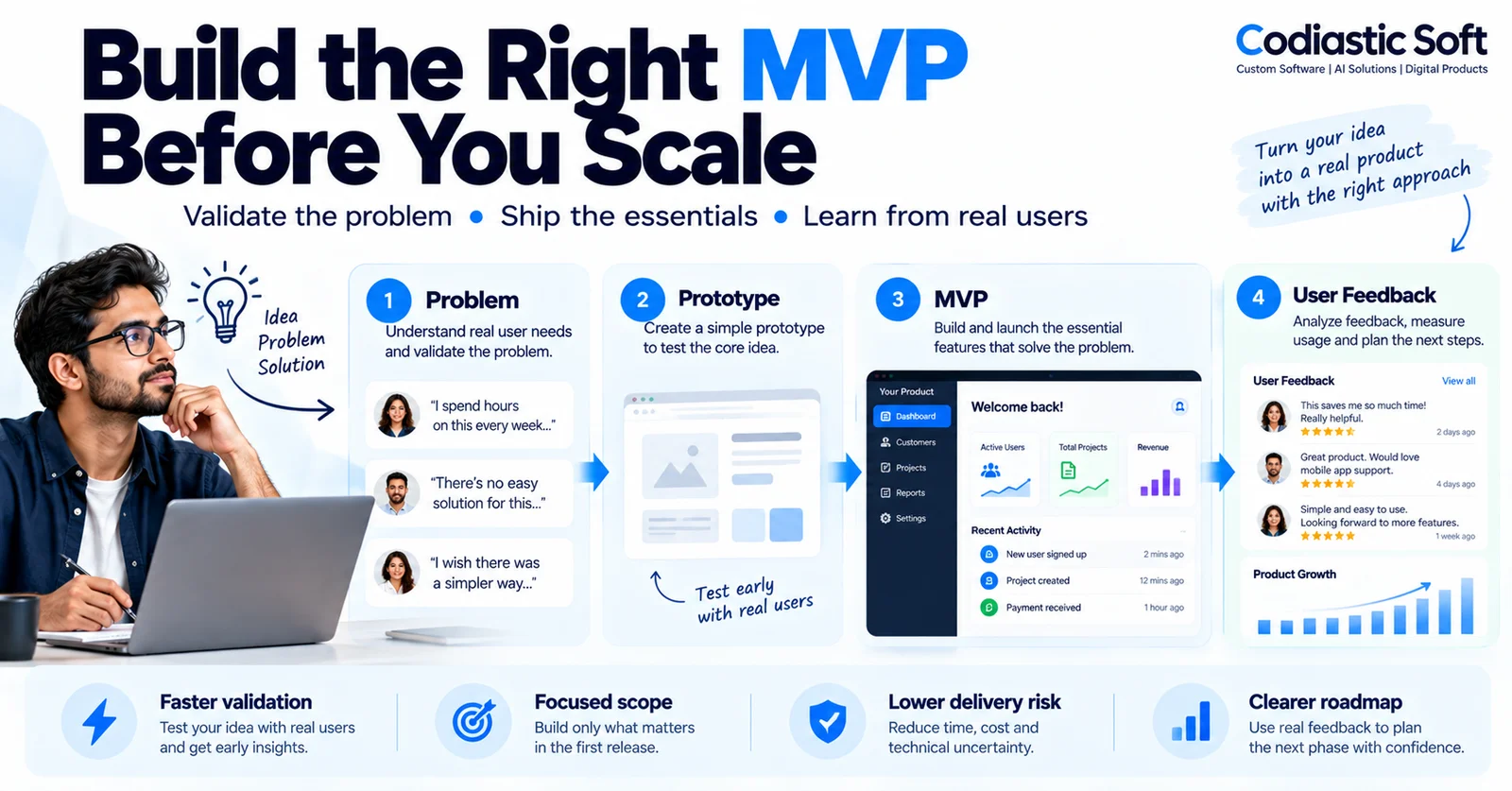
How to Build an MVP for Your Software Idea: A Practical Guide for Founders
Every successful software product begins with an idea. But turning that idea into a product people actually use requires more than development skills.
Founders often start with a long list of features: user registration, dashboards, payments, notifications, reports, mobile apps, AI capabilities, integrations, and an administrative panel.
The problem is that building everything at once can consume a significant amount of time and budget before the business has validated whether customers genuinely need the product.
This is where a Minimum Viable Product, or MVP, becomes valuable.
An MVP helps you launch a focused version of your product, test your assumptions with real users, and use their feedback to decide what to build next.
In this guide, we'll explain how to plan a software MVP, choose the right features, estimate development effort, avoid common mistakes, and prepare for a successful launch.
What Is a Minimum Viable Product (MVP)?
A Minimum Viable Product is the simplest useful version of a product that delivers its core value to a clearly defined group of users.
It is not simply a prototype, a poorly designed application, or a product with unfinished functionality.
An MVP should solve a real problem and allow you to learn whether your proposed solution works for the intended audience.
For example, imagine you're planning a rental marketplace.
Your long-term vision might include customer apps, vendor apps, delivery tracking, subscriptions, promotional campaigns, AI recommendations, analytics, and automated payouts.
But the first version may only need customer registration, product listings, availability, booking requests, vendor management, and a reliable booking workflow.
The initial objective is to validate the core marketplace experience before investing in advanced capabilities.
The principle is simple: build enough to test the business assumption, not every feature in the long-term vision.
Why Should Startups Build an MVP First?
1. Validate the Problem Before Scaling
An idea may sound promising without representing a sufficiently urgent problem for customers.
An MVP gives potential users something tangible to evaluate. Their actions, feedback, and willingness to pay provide stronger evidence than assumptions alone.
2. Control Initial Development Costs
Every additional feature introduces design, development, testing, and maintenance effort.
A focused first release helps you direct your budget toward the features that matter most.
3. Get to Market Earlier
A smaller, well-defined scope can make it easier to reach an initial group of users and begin learning from real-world usage.
The goal is not to release carelessly. It is to avoid delaying validation because of features that are not necessary for the first release.
4. Make Better Product Decisions
User feedback often reveals unexpected requirements.
You may discover that customers value a simple approval workflow more than advanced analytics, or that a mobile-friendly website is sufficient before developing separate mobile applications.
An MVP gives you evidence to guide these decisions.
5. Reduce the Risk of Building the Wrong Product
A large investment in an unvalidated product can create significant financial and operational risk.
A smaller initial release allows you to test critical assumptions before committing to a broader roadmap.
Step 1: Define the Problem and Target Customer
Before discussing technology or features, answer three questions.
Who is the product for?
Define the initial customer segment as specifically as possible.
For example, instead of targeting every small business, you might target distributors managing orders and inventory across multiple locations.
What problem are they experiencing?
Identify the current process, its limitations, and the consequences of those limitations.
Are employees entering the same data into multiple systems? Are customers unable to track bookings? Are managers struggling to obtain accurate reports?
What outcome should the product deliver?
Describe the result in business terms, such as reducing manual work, improving booking visibility, shortening processing time, or helping customers complete a task more easily.
A clear problem statement helps prevent the product from becoming a collection of unrelated features.
Step 2: Validate Demand Before Development
One of the most expensive mistakes is starting development before understanding the target audience.
You can validate an idea through customer interviews, competitor research, workflow observations, landing pages, clickable prototypes, or a limited pilot.
Ask potential users how they currently solve the problem, what they dislike about existing solutions, how frequently the problem occurs, and whether they would consider paying for a better solution.
Avoid asking only whether they like your idea. People may express enthusiasm without becoming actual users or customers.
Where possible, look for stronger signals, such as pilot commitments, pre-orders, repeated usage, or willingness to participate in testing.
The objective is not to prove that your original idea is perfect. It is to discover whether the problem is important enough to solve.
Step 3: Identify the Core User Journey
Map the main journey a user must complete to receive the product's value.
For a booking platform, that might be:
Discover an available service.
View details and pricing.
Select a suitable date or time.
Submit a booking.
Receive confirmation.
Track the booking status.
Each step should have a clear purpose.
If a feature does not help users complete the primary journey, meet an essential operational requirement, or validate a key business assumption, it may belong in a later release.
However, essential requirements such as secure authentication, permissions, data integrity, and payment safety cannot be ignored merely to reduce scope.
Step 4: Prioritize MVP Features
A useful way to organize requirements is to classify them into three groups.
Priority | Meaning | Example |
|---|---|---|
Must have | Required for the core product to function safely and deliver value | Booking creation and availability |
Should have | Valuable, but may be deferred if a safe workaround exists | Advanced reporting |
Later release | Useful after the initial product is validated | AI recommendations or advanced analytics |
Consider a SaaS product for managing internal business operations.
Its MVP may require authentication, user roles, core records, a primary workflow, basic reporting, and an administrative interface.
It may not initially require advanced predictive analytics, extensive theme customization, multiple mobile applications, or a complex marketplace of integrations.
Prioritization should be based on user needs, business risk, and the assumptions you need to test—not simply on which features are easiest to develop.
Step 5: Choose the Right Technology Stack
Technology should support the product requirements, team capabilities, expected usage, security needs, and future development plans.
For example, a web-based SaaS MVP may use:
Frontend: Next.js and React.
Backend: Node.js or Python with FastAPI, depending on the requirements.
Database: PostgreSQL for structured business data.
Mobile application: React Native or Flutter when a dedicated mobile experience is justified.
Infrastructure: AWS or another suitable cloud provider.
Integrations: Well-defined APIs for payments, notifications, analytics, and external systems.
These are examples, not universal requirements. A simpler product may need fewer components, while a real-time or data-intensive platform may require a different architecture.
Avoid introducing microservices, complex infrastructure, or multiple databases without a clear technical reason.
At the same time, do not sacrifice security, maintainability, or data integrity just to achieve a faster initial release.
Step 6: Design the User Experience Before Full Development
A prototype helps you evaluate the product's user journey before investing in complete implementation.
Start with wireframes for the main screens and workflows. Then create a clickable prototype that potential users can navigate.
Test whether users understand what to do, can complete the main task, and recognize the value of the proposed solution.
This process can reveal confusing navigation, missing steps, and unnecessary functionality before those problems become expensive to change.
The goal is not to perfect every screen. It is to establish a clear and usable experience for the core journey.
Step 7: Estimate the Development Scope Realistically
MVP development effort depends on the product's complexity rather than its label.
A basic internal tool with a few screens is very different from a multi-vendor marketplace, financial platform, or SaaS application with multiple user roles and third-party integrations.
A realistic estimate should account for:
Discovery and requirement clarification.
UI/UX design.
Frontend and backend development.
Database design and data migration, where applicable.
Integrations and external service dependencies.
Authentication, permissions, and security.
Testing and defect correction.
Deployment, monitoring, and production readiness.
Documentation, training, and support.
Ask your development team to identify assumptions, exclusions, dependencies, and risks.
A phased estimate can be particularly useful when requirements are still evolving. It allows you to establish the cost of the initial release separately from future enhancements.
Step 8: Build, Test, and Launch in Controlled Stages
Development should follow a clear sequence.
First, establish the foundation: project structure, authentication, data models, permissions, and core workflows.
Next, implement the essential user journey and connect the necessary integrations.
Then test realistic scenarios, including invalid input, failed API calls, duplicate requests, permission boundaries, and recovery from errors.
Before launch, prepare production infrastructure, backups, logging, monitoring, and a process for handling user feedback and incidents.
Start with a limited group of users when possible. A controlled pilot can reveal issues before the product is exposed to a larger audience.
An MVP should be small in scope, not careless in quality.
Step 9: Measure What Happens After Launch
Launching the product is the beginning of validation, not the end.
Define a small set of metrics tied to the problem you want to solve.
Depending on the product, useful metrics may include:
Activation: how many users complete the initial setup or core action.
Engagement: whether users return and continue using the main feature.
Conversion: whether trial users become paying customers.
Retention: whether customers continue receiving value over time.
Task completion: whether users successfully finish the intended workflow.
Operational efficiency: whether the product reduces manual effort or processing time.
Reliability: whether the system works consistently under real usage.
Choose metrics that reflect the product's purpose. A booking platform, an internal operations tool, and a subscription SaaS product will not have identical success measures.
Collect qualitative feedback as well. Analytics can show where users leave a workflow, while interviews may explain why.
Step 10: Plan the Next Release Based on Evidence
After the initial launch, group feedback into recurring problems, requested improvements, defects, and speculative features.
Prioritize changes according to user impact, business value, effort, and risk.
For example, if users repeatedly struggle with onboarding, improving onboarding may be more valuable than introducing a complex AI feature.
If the core workflow is working well but customers need better reporting, reporting may become the next development priority.
A product roadmap should evolve as evidence improves.
Common MVP Development Mistakes
Building Too Many Features
A long feature list can delay launch and make it harder to understand which capabilities actually create value.
Start with the core user journey and essential operational requirements.
Skipping Customer Research
Developers can build a technically impressive product that solves the wrong problem.
Validate the problem with the people who experience it.
Treating an MVP as a Prototype
A prototype tests ideas and interactions. An MVP is a usable product that delivers real value to its intended users.
The distinction matters when planning architecture, security, testing, and deployment.
Choosing Technology Based Only on Trends
A fashionable framework does not guarantee product-market fit or technical success.
Choose tools based on requirements, maintainability, integration needs, and the capabilities of the team that will support the product.
Ignoring Security and Reliability
Even a small first release may process customer data, payments, or confidential business information.
Appropriate access controls, validation, backups, monitoring, and testing should be included from the beginning.
Failing to Plan for Feedback
Without defined success metrics and a process for reviewing feedback, teams may continue adding features without learning whether the product is succeeding.
Plan the validation process before launch.
How Much Does It Cost to Build an MVP?
There is no single price for an MVP.
The cost depends on the number of workflows, user roles, integrations, platform requirements, design complexity, security needs, and expected production readiness.
A focused internal web application may be relatively straightforward. A multi-vendor marketplace, subscription SaaS platform, or mobile application with payments and complex integrations requires more effort.
The most useful first step is to define the target users, core problem, essential features, and acceptance criteria.
A development team can then prepare a phased scope and estimate, separating must-have capabilities from optional enhancements.
This avoids comparing proposals based only on price when they may cover very different levels of functionality and quality.
Final Thoughts
Building a successful software product is not about delivering the largest number of features in the shortest time.
It is about solving a meaningful problem, learning from real users, and investing in the right capabilities at the right stage.
A well-planned MVP provides a practical starting point: validate the problem, map the core user journey, prioritize essential functionality, choose suitable technology, test thoroughly, and use evidence to guide the next release.
At Codiastic Soft, we help businesses turn software ideas into practical digital products through product planning, UI/UX design, web and mobile application development, SaaS engineering, integrations, and AI solutions.
Whether you are planning a startup MVP, an internal business application, a marketplace, or a new SaaS platform, the right starting point is a clear understanding of the problem and the smallest useful solution.
Explore our software development services, review our portfolio, and see our case studies.
Have a software idea? Start by defining the problem, identifying your first group of users, and deciding what the first version must accomplish. Those three decisions will make the development conversation much more productive.
Frequently Asked Questions
What should be included in a software MVP?
Include the features required to solve the primary user problem, complete the core workflow, and validate the most important business assumptions. Security, data integrity, and essential operational requirements must also be covered.
How long does it take to develop an MVP?
Timelines vary with scope, integrations, platform requirements, design, and testing. A focused web application can be much simpler than a multi-role marketplace or a regulated financial platform. A discovery phase helps establish a realistic estimate.
Should I build a website, mobile app, or both?
Choose based on how your target users need to access the product. A responsive web application may be sufficient for initial validation. Dedicated mobile apps make sense when device capabilities, usage patterns, or customer expectations justify them.
Can I add AI to my MVP?
Yes, if AI is central to the problem being solved or provides a clear, testable benefit. Start with a defined use case and evaluate accuracy, cost, privacy, reliability, and the need for human review.
What happens after an MVP launches?
Measure usage, interview users, review operational data, resolve defects, and prioritize improvements. The next release should be guided by evidence rather than automatically following the original long-term feature list.
How do I choose a software development partner?
Look for clear requirements discovery, transparent scope and estimates, relevant technical experience, testing and deployment practices, communication, ownership arrangements, and a credible maintenance plan. A good partner should challenge unnecessary scope as well as explain the trade-offs involved.

Written by
Codiastic Soft Team
We build websites, mobile apps, SaaS products and automation for growing businesses in Pune and worldwide. About us →
Keep reading
More from our blog
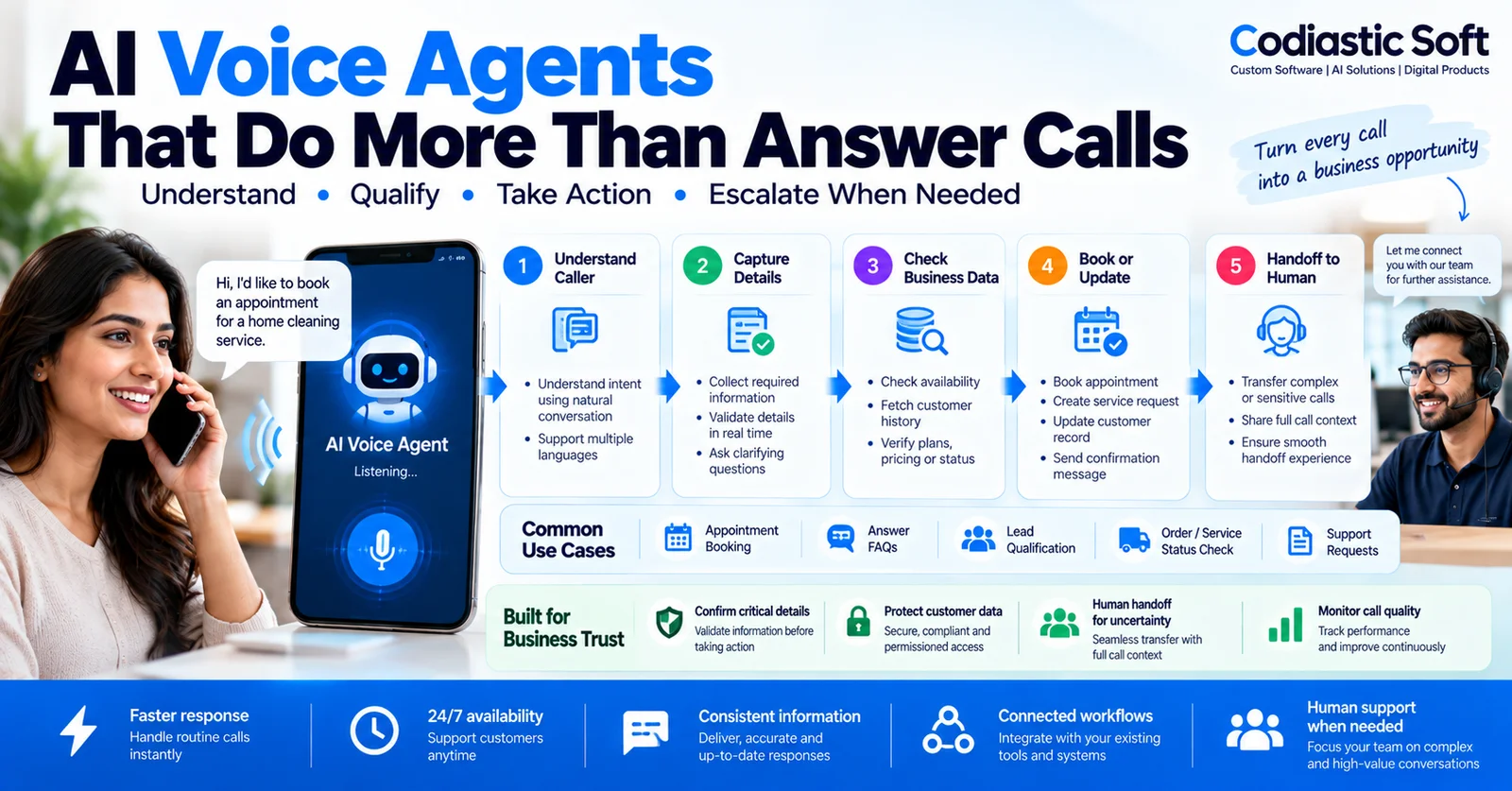
AI & Automation
AI Voice Agents for Business: Use Cases, Integrations and Best Practices
Read article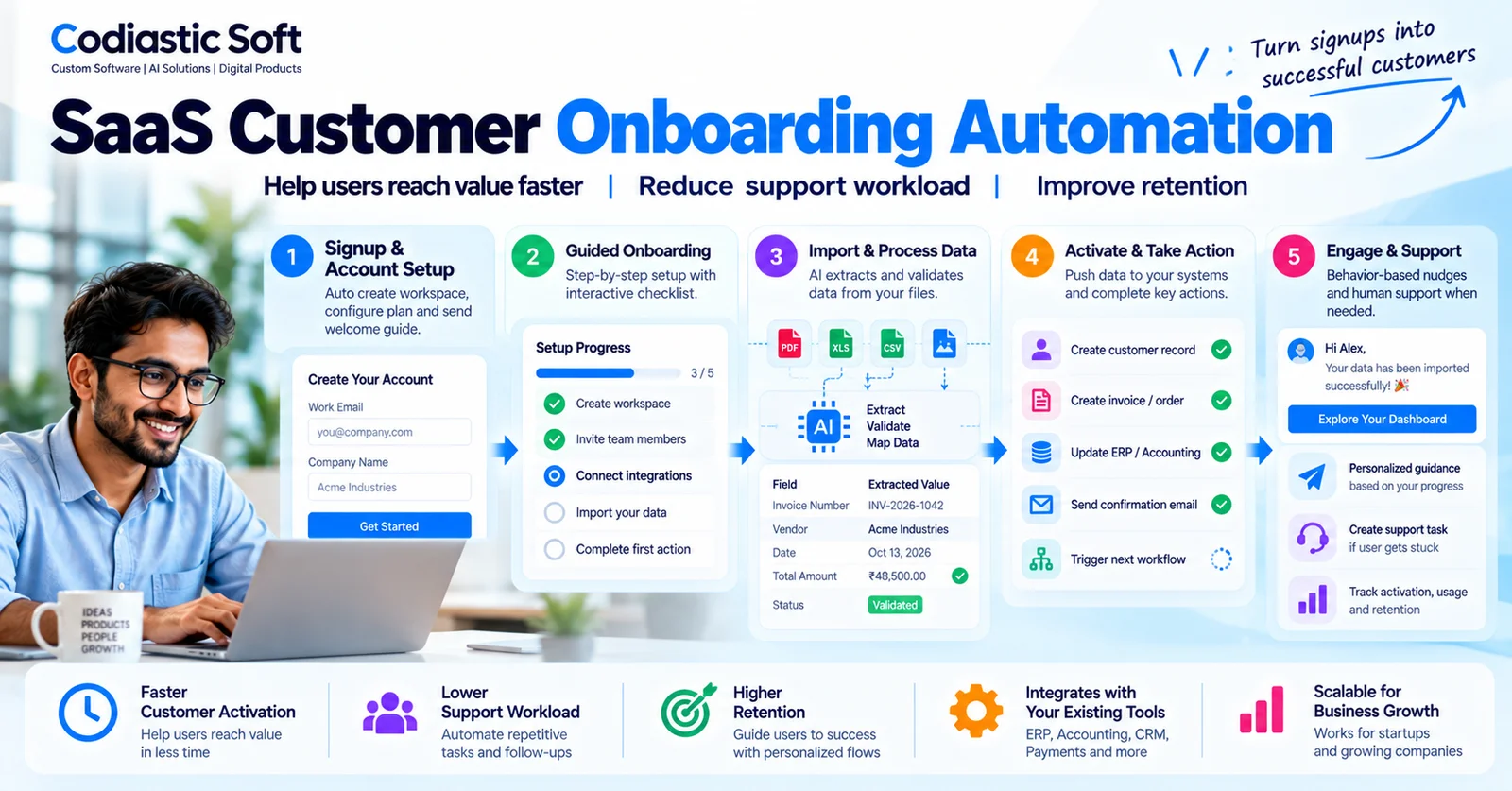
SaaS & Product Development
SaaS Customer Onboarding Automation: Improve Activation Without Adding More Staff
Read article
AI & Automation