
AI Defect Detection in Manufacturing: What You Need Before Building a Computer Vision System
AI-powered visual inspection can help manufacturers detect product defects faster and more consistently. But successful defect-detection systems require much more than an AI model. This guide explains the cameras, lighting, datasets, defect definitions, model validation, production integration and human-review workflows businesses should consider before investing in an AI inspection system.
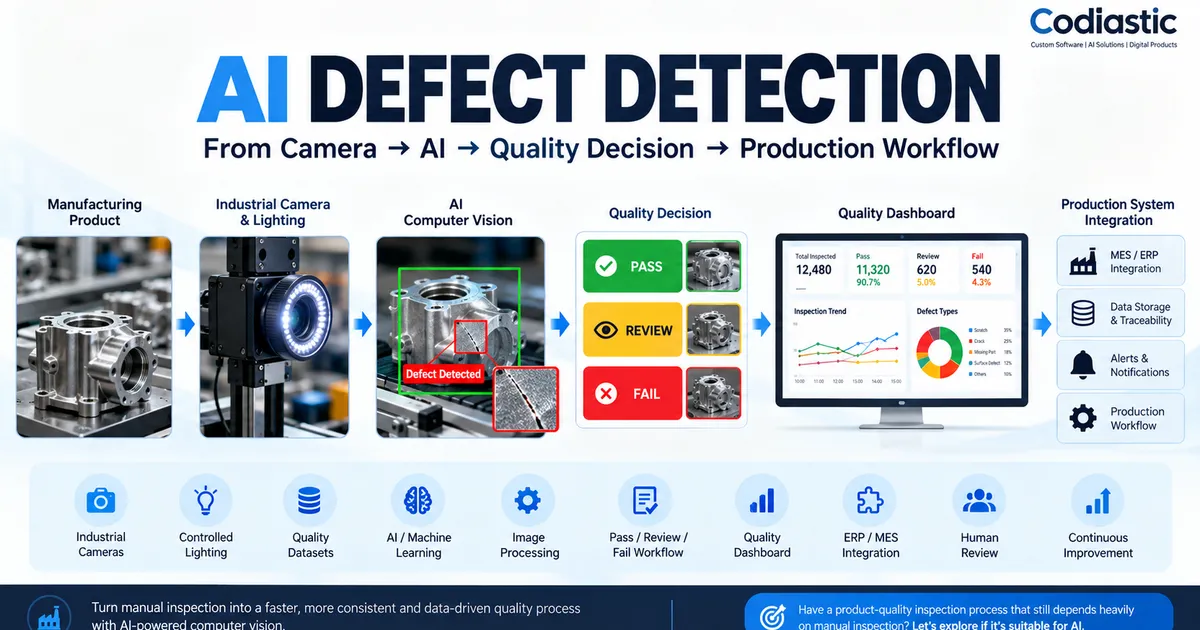
AI Defect Detection in Manufacturing: What You Need Before Building a Computer Vision System
Manufacturers have been using visual inspection for decades.
An operator looks at a product, checks it against quality standards, identifies defects and decides whether the product should pass, be reworked or be rejected.
The problem is that this process becomes increasingly difficult as production volume increases.
Inspectors can get tired. Products can move faster. Defects can be extremely small. Different operators may interpret the same defect differently.
This is where AI-powered computer vision becomes interesting.
Instead of relying entirely on manual inspection, cameras and AI models can be used to analyse products and identify specific visual defects.
But there is an important misconception:
Building an AI defect-detection system is not simply a matter of training a model and putting a camera in front of a production line.
The AI model is only one component of the complete system.
What does AI defect detection actually do?
A typical computer-vision inspection system can capture an image or video of a product and analyse it for predefined characteristics.
Depending on the application, the system may identify:
Scratches
Cracks
Surface damage
Missing components
Incorrect assembly
Shape abnormalities
Colour variations
Printing defects
Packaging problems
Contamination
Dimensional abnormalities
Foreign objects
The system can then classify the product as:
PASS → REVIEW → FAIL
The result can also be stored in a database and connected to existing manufacturing software.
1. Start with the defect, not the AI model
One of the biggest mistakes businesses make is starting with:
“We want to implement AI.”
The better question is:
“Which quality problem are we trying to solve?”
For example:
Instead of saying:
“We need an AI inspection system.”
Define the problem as:
“We produce 30,000 components every day and need to identify surface scratches before packaging.”
That immediately makes the project easier to evaluate.
You can define:
What constitutes a defect?
What is an acceptable product?
What is a rejected product?
Which defects are critical?
What is the acceptable false-rejection rate?
How quickly must the system respond?
AI should be applied to a measurable manufacturing problem.
2. Camera and lighting can be more important than the model
This is one of the most overlooked parts of computer vision.
Imagine trying to identify a small scratch on a metallic component.
If the lighting changes, the reflection changes.
The same component can look completely different depending on:
Camera angle
Light intensity
Light direction
Surface reflection
Product orientation
Background
Camera distance
Lens quality
This means a highly sophisticated AI model cannot automatically compensate for poor image acquisition.
A successful inspection system may require careful design of:
Camera + Lens + Lighting + Product Positioning + Image Processing + AI Model
In some applications, improving the lighting can produce a bigger improvement than changing the AI architecture.
3. You need representative data
The next major challenge is data.
An AI model needs examples of what it should detect.
That usually means collecting images representing:
Good products
Examples of products that should pass inspection.
Defective products
Examples of different defect types.
Borderline products
Products where the quality decision may not be obvious.
This third category is extremely important.
In real manufacturing environments, the challenge is often not identifying an obviously damaged product.
The difficult question is:
“Is this defect serious enough to reject the product?”
Your dataset needs to represent those real-world situations.
4. Don't measure the AI only on training accuracy
A model can perform extremely well on a controlled dataset and still perform poorly inside a factory.
Why?
Because production environments introduce variables that may not exist in the training data.
For example:
Different product batches
Different materials
Different lighting conditions
Camera vibration
Dust
Temperature changes
Product positioning differences
New defect types
Different product variants
Therefore, testing should happen using real production-like conditions.
The important question isn't:
“How accurate is the model?”
The better question is:
“How reliably does the complete system perform on production data?”
5. False positives and false negatives matter
Imagine an AI system incorrectly identifies a good product as defective.
That is a:
False Positive
Now imagine the system allows a defective product to pass.
That is a:
False Negative
Both can have business consequences.
For some manufacturing applications, missing a defect could be extremely expensive.
For others, rejecting too many good products could create unnecessary waste.
Therefore, the AI system needs to be evaluated according to the actual economics and risk of the manufacturing process.
6. AI doesn't always have to replace humans
A better approach in many environments is AI-assisted inspection.
Instead of:
Human → performs everything
you can build:
Camera → AI inspection → Human review → Final decision
For example:
PASS
AI is highly confident the product is acceptable.
→ Automatically continue.
FAIL
AI identifies a clear defect.
→ Automatically reject or send for rework.
REVIEW
AI is uncertain.
→ Send the product to a human inspector.
This creates a human-in-the-loop system.
It can be particularly useful during the early stages of deployment.
7. The system needs to connect to the factory
Computer vision becomes much more valuable when it is connected to the rest of the manufacturing workflow.
For example:
The system could potentially integrate with:
PLC systems
Manufacturing software
ERP
MES
Quality management systems
Production dashboards
Barcode/RFID systems
Notifications
Analytics platforms
This turns computer vision from an isolated AI experiment into an actual business system.
8. Start with a narrow pilot
You don't necessarily need to automate an entire factory on day one.
A better approach is:
Phase 1
Choose:
One product
One production line
One or two defect types
One inspection point
Then measure:
Detection performance
False positives
False negatives
Inspection speed
Operator intervention
Cost per inspection
Production impact
If the pilot works, expand it.
For example:
1 defect → 5 defects → multiple products → multiple lines
This reduces project risk and gives management measurable evidence before scaling.
What does a complete AI inspection system look like?
A practical architecture could look like this:
This architecture can be adapted according to the factory, product and inspection requirements.
What businesses should consider before investing
Before starting an AI defect-detection project, answer these questions:
What exact defect are we trying to detect?
How frequently does it occur?
What does an acceptable product look like?
What does a rejected product look like?
How many samples are available?
How fast must inspection happen?
What camera resolution is required?
What lighting conditions are required?
What happens when AI is uncertain?
Does the system need to operate on-premise or in the cloud?
Does it need to integrate with PLC/MES/ERP?
What happens when the model encounters a new defect?
These questions are often more important than simply asking:
“Which AI model should we use?”
Can AI defect detection work?
Yes—but it should be treated as an engineering project, not simply an AI-model project.
The successful solution usually combines:
Computer Vision + AI/ML + Image Processing + Hardware + Software + Integration + Monitoring + Human Workflow
The goal isn't to build the most impressive AI demo.
The goal is to build a system that works reliably enough to improve a real manufacturing process.
At Codiastic Soft, we have worked on an AI-powered product defect detection solution through Defect IQ, combining AI software with a business-facing digital platform for quality-inspection workflows.
That experience reinforces an important principle:
The best AI solutions begin with the business problem—not the AI technology.
If your manufacturing process currently depends heavily on manual visual inspection, the first step should be a feasibility assessment of the product, defects, available data, inspection environment and expected ROI.

Written by
Codiastic Soft Team
We build websites, mobile apps, SaaS products and automation for growing businesses in Pune and worldwide. About us →
Keep reading
More from our blog
Artificial Intelligence
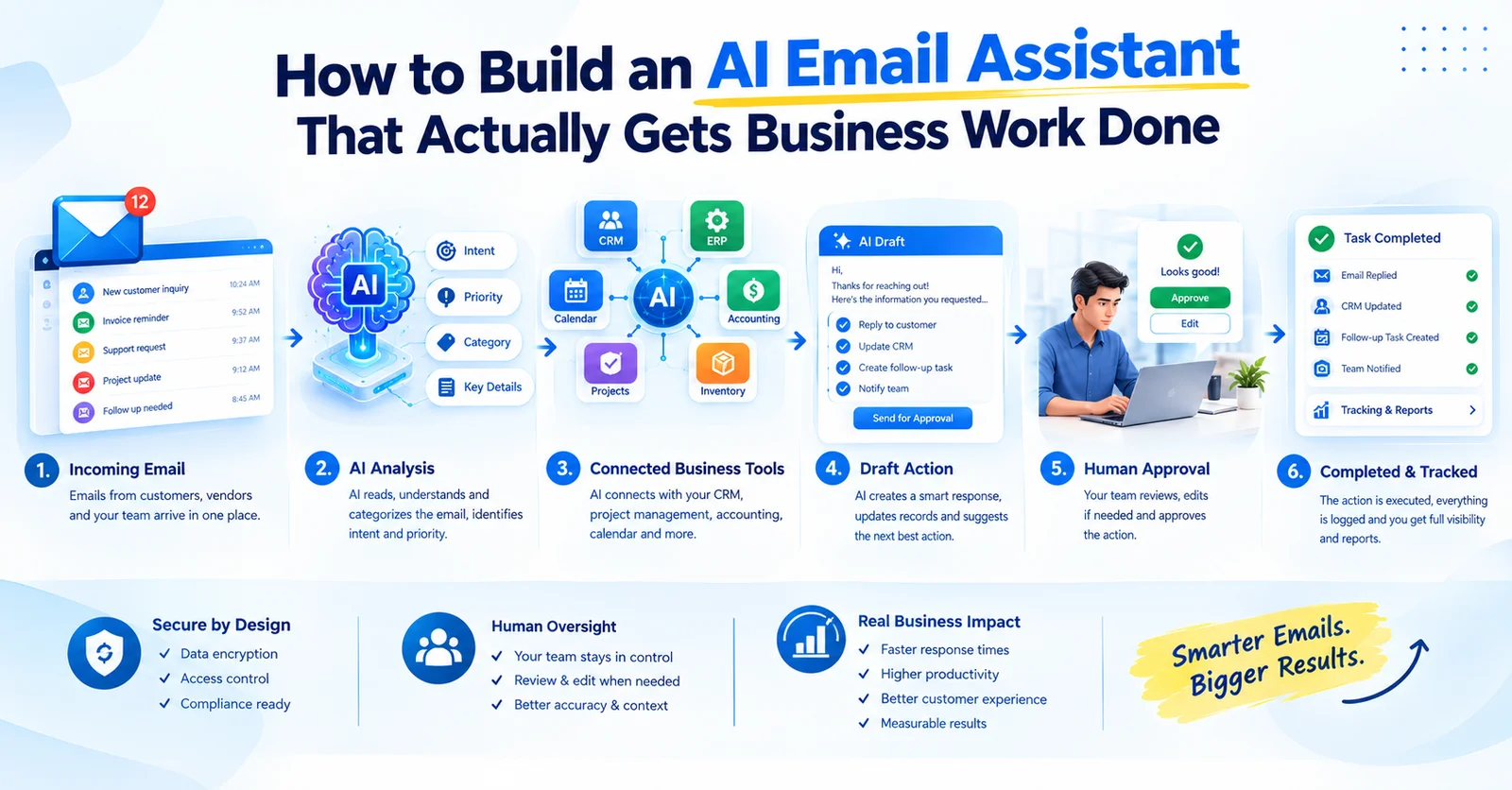
How to Build an AI Email Assistant That Actually Gets Business Work Done
Read article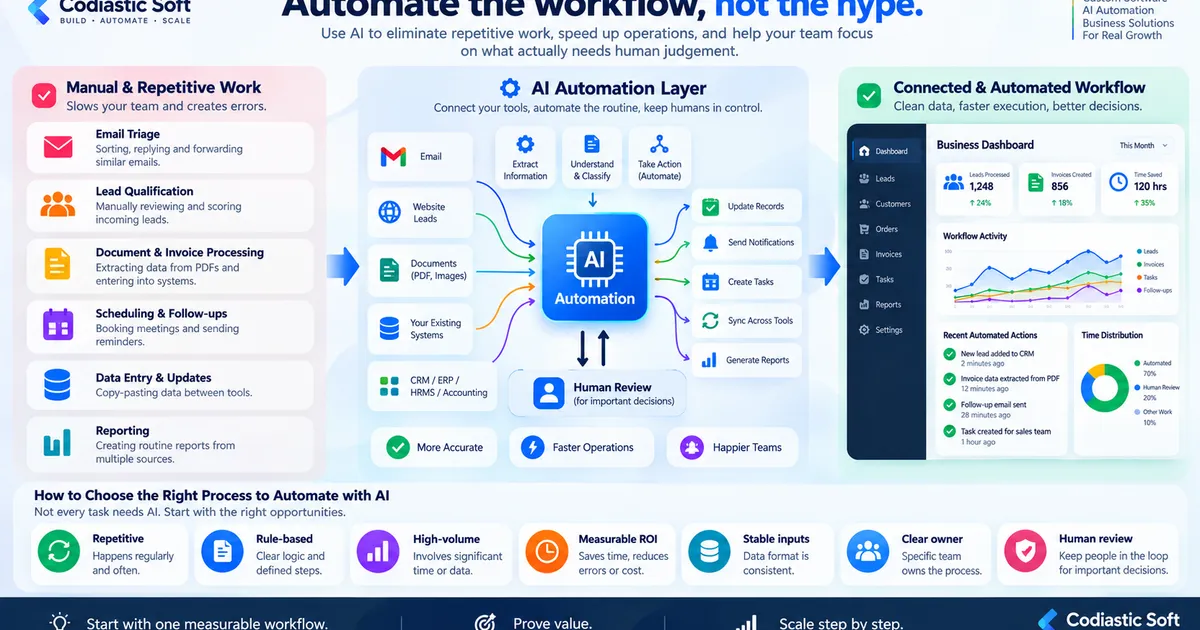
Artificial Intelligence
What Business Processes Should You Automate With AI? A Practical Guide
Read article
AI & Automation